The time from admission to undergoing PCI has halved after Chest Pain Centre opened
Dominic has just turned 69, and one of his birthday wishes is to stay healthy. The wish arose from a brush with death one Sunday morning in May last year when he woke up feeling unusually exhausted. "I felt drained, with numbness in my hands and feet," he recalls. His wife helped him back to bed while his son immediately called an ambulance.
Straight to Cardiac Catheterisation Laboratory via ‘Green Channel'
On his way to Queen Mary Hospital (QMH), ambulanceman performed an electrocardiogram (ECG) and transmitted the data to the hospital for an urgent assessment. On arrival, doctors found one of his coronary arteries' blockages were more than 90%, putting him at imminent risk of a heart attack. The multidisciplinary team activated the dedicated ‘Green Channel' for cardiovascular emergencies and transferred Dominic straight to the Cardiac Catheterisation Laboratory for percutaneous coronary intervention (PCI) – treatment using a balloon to open a blocked artery. From his arrival at the Accident and Emergency (A&E) Department to the restoration of coronary blood flow, the entire process took just 67 minutes.
"I had no relevant medical history, and the attack came out of the blue," Dominic reflects on the life-threatening experience. "My family and I were very worried. Thankfully, the professional healthcare team responded swiftly. Everything went smoothly, and they pulled me back from the brink. I am truly grateful."
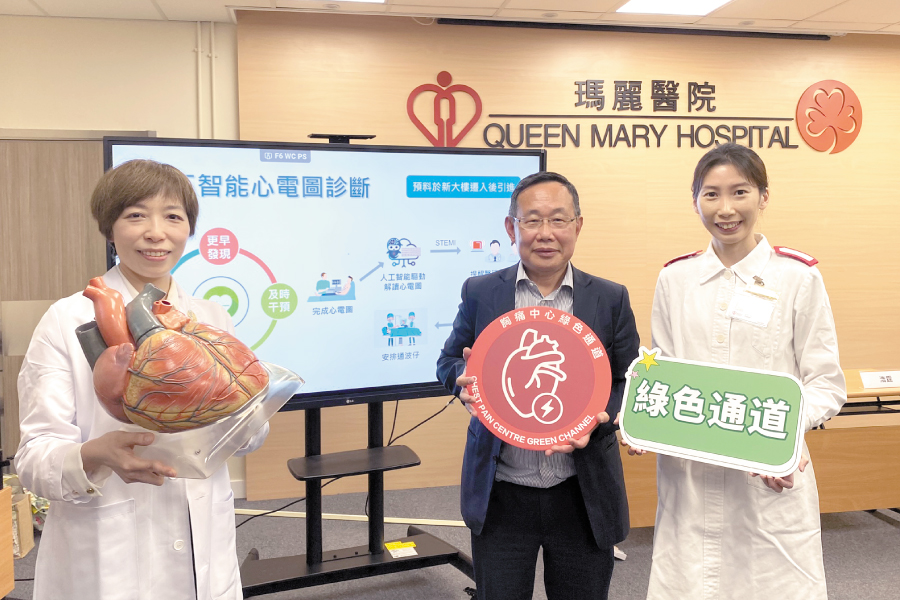
QMH's Chest Pain Centre opened in last November and obtained national accreditation in May this year, becoming the first accredited Chest Pain Centre in Hong Kong. Department of Medicine Consultant Dr Carmen Chan notes the median ‘door-to-balloon' time had shortened to 53 minutes by September – well within the national benchmark of 90 minutes and nearly half of the previous time of 105 minutes, greatly helps improve patient survival rates. Around 1,400 patients with cardiovascular disease have so far received timely treatment through the 'Green Channel', and 162 patients in critical condition have received immediate PCI.
Introduce AI ECG for risk assessment
Every second counts in treating cardiovascular diseases, and Dr Chan says QMH is continuing to enhance its service levels. Clinical services will be relocated gradually to the hospital's new block starting from the end of this year. The number of cardiac catheterisation laboratories will increase to three, the number of cardiac day beds will increase to six, and there will be dedicated lift linking directly to A&E to streamline patient transfer and overall workflow. The centre will also introduce an AI-enabled ECG machine to stratify patients into high-risk, medium-risk, and low-risk categories, enabling earlier identification of urgent cases, better streaming, and improving diagnostic accuracy and efficiency. Prince of Wales Hospital will establish Hong Kong's second Chest Pain Centre next year.
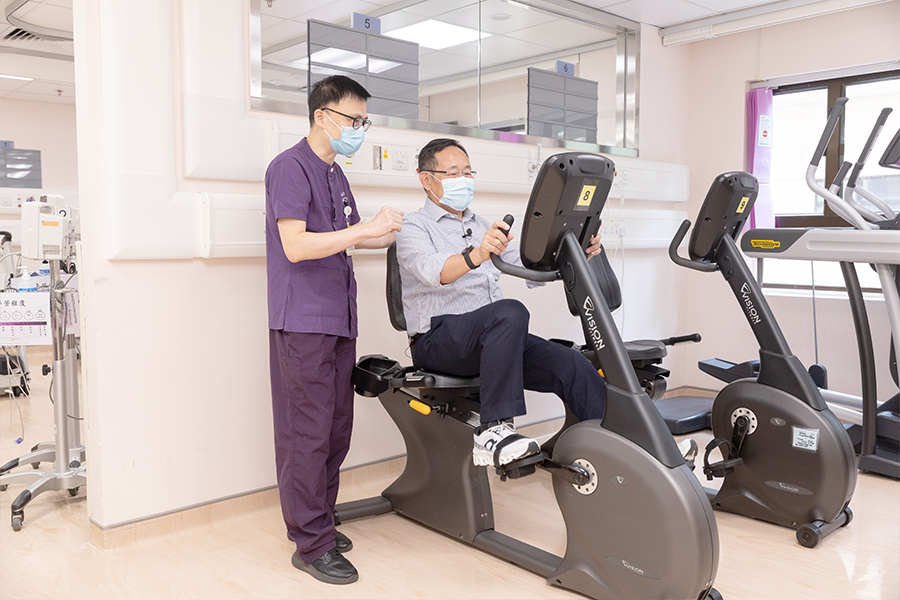
It is essential for patients with acute cardiovascular disease to have rehabilitation training. After the discharge, Dominic was referred to Tung Wah Hospital for cardiac rehabilitation. Cardiac Rehabilitation & Prevention Centre Ward Manager Eunice Kwok says patients are assessed by a multidisciplinary clinical team and given a personalised rehabilitation plan. The 12-session programme includes physiotherapists and occupational therapists providing aerobic exercise, strength training, Baduanjin exercises, work simulation, as well as dietitians, clinical psychologists and pharmacists providing health education, helping patients establish healthy lifestyle and rebuild their fitness and confidence step by step.
Dominic attended classes twice a week and has put his health and daily life back on track with the help of cycling, treadmill runs, and weighted sandbag drills for conditioning. "I work up a good sweat after each session, and my energy and strength have clearly improved," he says with a smile.